AI Chat vs Workflows vs Agents: Which Do You Need?
78% of businesses use AI but most just chat with it. The real ROI is in structured workflows. Here is how to know which approach fits your business.
The Copy-Paste Ceiling
Your team “uses AI.” They open ChatGPT, paste in a client brief, copy the output, drop it into a document, tweak it, and move on. Repeat for proposals, emails, research summaries, meeting prep.
That is not automation. That is a faster typewriter.
78% of organizations now use AI in at least one business function. Most of them are doing exactly this. And the results look underwhelming because the approach has a hard ceiling: every task still requires a human to start it, copy the output, and act on it. Nothing runs on its own. Nothing compounds.
The 6% of companies that capture real value from AI are doing something different. McKinsey data shows 55% of high performers redesigned their workflows around AI, compared to just 20% of everyone else. The difference is not better tools. It is a different architecture.
There are three distinct ways to use AI in a business, and most people conflate them. Understanding the differences changes how you invest your time and money.
The Three Approaches
AI Chat Interfaces
ChatGPT, Claude, Gemini. You type, it responds, you act on the output. Every interaction is a one-off. The AI has no memory of what you asked yesterday (unless you configure it), no connection to your business systems, and no ability to trigger actions anywhere.
What it is good at:
- Drafting content, emails, and documents
- Brainstorming and exploring ideas
- Ad-hoc research and summarization
- Learning new concepts quickly
- One-off tasks that do not repeat
What it cannot do:
- Run without a human initiating every interaction
- Connect to your CRM, invoicing system, or email
- Execute the same process consistently every time
- Scale beyond what one person can copy-paste
MIT research found that AI chat tools help knowledge workers complete tasks 40% faster with measurably higher quality output. That is real. But those gains are personal productivity gains. They do not show up on the P&L because the output still depends entirely on one person remembering to open the chat, writing the right prompt, and manually moving the result somewhere useful.
Workflow Automation
A trigger fires, a sequence of steps executes, an output is produced. No human intervention needed. The logic is defined once and runs reliably every time. Tools like n8n, Zapier, Make, or custom scripts handle the orchestration. AI can be embedded as a step within the workflow, for example, “classify this email with an LLM, then route it based on the classification.”
What it is good at:
- Processes that repeat more than once a week
- Data sync between systems (CRM, email, spreadsheets, invoicing)
- Lead routing and enrichment
- Automated reporting and alerts
- Anything that follows a predictable sequence
What makes it different from chat: Once built, it runs without a human. The ROI compounds as volume increases. A workflow that saves 20 minutes per lead across 200 leads per month saves 66 hours. That is a part-time employee’s worth of work, running on autopilot.
Forrester’s Total Economic Impact research found a three-year ROI of 248% for enterprise automation, with payback in under six months. Error rates drop significantly compared to manual processing because the system does not skip steps, forget fields, or lose focus on a Friday afternoon.
AI Agents
Goal-oriented systems that plan, reason, and execute multi-step tasks autonomously. Given an objective, an agent decides how to achieve it, calls tools and APIs, interprets results, and continues until the goal is met or it needs to escalate. The path to completion is decided at runtime, not at design time.
What it is good at:
- Tasks requiring judgment that cannot be pre-scripted
- Handling unstructured inputs (varied email formats, free-text requests)
- Exception handling where rules break down
- Complex research spanning multiple sources
- Multi-step reasoning before taking action
What it costs: Agentic workflows with multi-step reasoning and tool calls consume significantly more tokens per task than a single chat completion. Anthropic flags this directly in their agent design guidance. A workflow automation task costs fractions of a cent. An agent completing the same task costs substantially more because it involves multiple LLM calls, tool invocations, and reasoning loops. That is worth it for complex, judgment-heavy work. It is wasteful for tasks that follow predictable steps.
Anthropic, the company behind Claude, puts it directly: “Start with simple prompts, optimize them with comprehensive evaluation, and add multi-step agentic systems only when simpler solutions fall short.”
When to Use What
The choice is not about which approach is “best.” It is about matching the tool to the problem.
| If the task… | Use |
|---|---|
| Is a one-off that requires creative thinking | AI Chat |
| Happens once and never repeats | AI Chat |
| Repeats weekly and follows the same steps | Workflow Automation |
| Needs to run without someone starting it | Workflow Automation |
| Requires an audit trail | Workflow Automation |
| Involves varied, unstructured inputs | AI Agent |
| Requires judgment that cannot be written as rules | AI Agent |
| Needs to handle frequent, unpredictable exceptions | AI Agent |
Most real business processes benefit from a hybrid approach: a structured workflow handles the backbone (triggering, routing, logging, data validation), and AI is called for specific steps that require interpretation or generation.
For example, an inbound lead workflow: a form submission triggers the automation, an LLM scores the lead and classifies intent, the CRM is updated automatically, and if the lead scores high, a personalized email draft is generated for human review. Deterministic structure for reliability. AI at the decision points for intelligence.
This is the architecture we build for most of our clients. The structured workflow ensures nothing falls through the cracks. The AI steps handle the parts that would otherwise require a human to read, interpret, and decide.
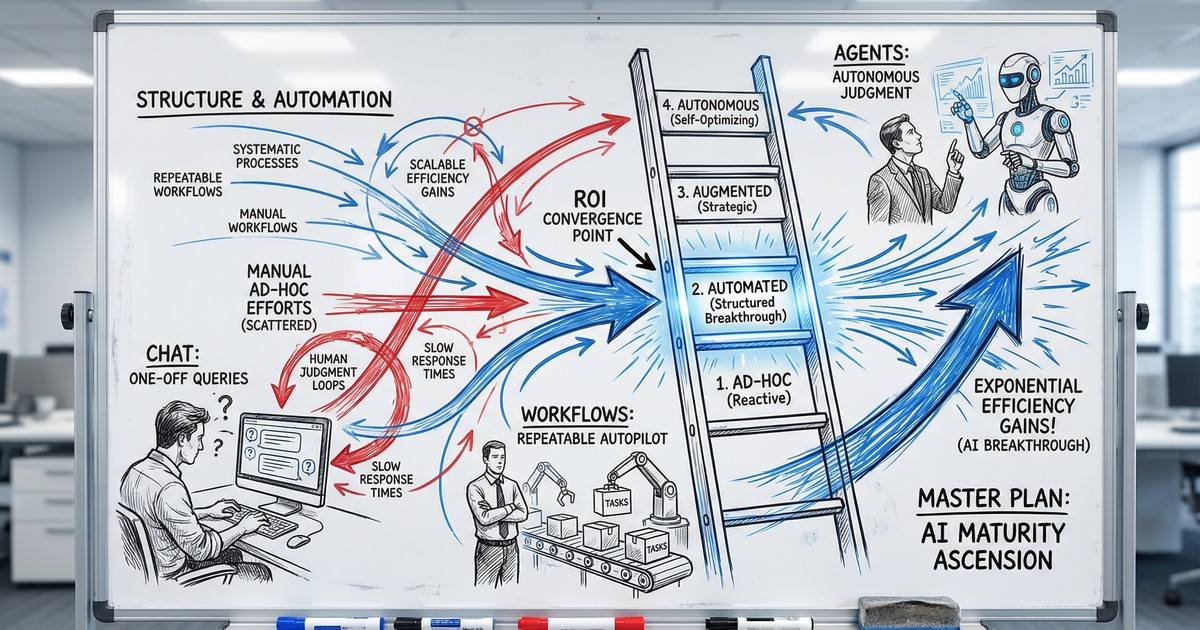
The Maturity Ladder
Most businesses progress through four stages. Knowing where you are helps you understand what to invest in next.
Stage 1: Chat (where most businesses are)
AI is used as a better search engine. Team members ask ChatGPT for drafts, summaries, and answers. No integrations, no automation. Individual productivity gains are real but do not compound.
The ceiling: Saving one person 40 minutes per day is useful. But it does not change how the business operates. The process is still manual. The output is still inconsistent. And if that person leaves, the “AI capability” leaves with them.
Stage 2: Workflow Automation (the biggest ROI jump)
Repeatable processes are mapped, built as automated pipelines, and run without human intervention. AI is introduced as a capability within specific steps. The business starts producing outputs that are consistent, scalable, and auditable.
Why this matters most: The jump from Stage 1 to Stage 2 is the highest-return move most businesses can make. Forrester’s research shows enterprise automation delivering nearly 250% ROI within three years. And unlike chat-based usage, these gains scale with volume.
If you understand the concepts behind how LLMs work, you can make better decisions about where AI fits in these workflows. We wrote a practical guide to LLMs for business owners that covers exactly this.
Stage 3: Hybrid (workflows + AI judgment)
The automation handles the deterministic backbone. AI is called for steps requiring interpretation, classification, generation, or scoring. The system is robust (workflow structure) and intelligent (AI at decision points).
This is where most well-run businesses should aim to operate. It combines the reliability of structured automation with the flexibility of AI reasoning, without the unpredictability of fully autonomous agents.
Stage 4: Agentic (emerging, bounded use cases)
Autonomous agents handle open-ended, judgment-heavy tasks with minimal human oversight. Currently viable for specific, well-scoped processes but not a general-purpose solution.
The reality check: Gartner’s 2024 Hype Cycle places agentic AI squarely at the “Peak of Inflated Expectations.” Enterprise deployment is minimal. McKinsey’s March 2025 data shows two-thirds of organizations have not yet begun scaling AI beyond pilots. Agents are powerful for bounded use cases, but premature adoption is expensive.
Five Mistakes to Avoid
1. Treating ChatGPT as a production system
The most common error. Teams copy content into chat, get output, paste it somewhere else, and call it “using AI.” This creates inconsistency (different prompts produce different outputs), does not scale, and is not auditable. It is personal productivity, not business automation.
The data: 77% of employees report that AI has actually increased their workload, largely due to managing disconnected AI tools and correcting outputs. If your “AI strategy” is giving everyone a ChatGPT license, this is why the results are disappointing.
2. Skipping workflows entirely
The hype cycle is pushing businesses straight from chat to agents, skipping the automation stage entirely. This is the most expensive path. Workflow automation has proven ROI, well-understood tooling, and fast implementation. Most workflows go live in under 30 days. Agents require substantially more governance, monitoring, and engineering investment.
3. Building agents when a workflow would do
If the process can be drawn as a flowchart with no ambiguous branches, it is a workflow problem, not an agent problem. Agents are for tasks where the path to completion cannot be predetermined. Using them for structured, repeatable processes is like hiring a strategy consultant to do data entry.
4. Confusing “exploring AI” with having an AI strategy
A few ChatGPT licenses, a marketing team experimenting with AI image generation, a developer using Copilot. This is tool adoption, not transformation. 78% of companies use AI in at least one function, but only 6% qualify as high performers. The gap is not access to AI. It is the absence of structured processes to plug AI into.
5. Waiting for the “right” tool
There is no perfect tool. The right time to automate your most painful workflow was six months ago. The second-best time is this week. The best practices for workflow automation have not changed: start small, prove value, expand.
How to Move Up
If you are at Stage 1 (chat), here is the path forward:
Step 1: Audit your repetitive work. For one week, track every task that follows the same steps each time. Lead qualification, invoice processing, report generation, data entry between systems, client onboarding emails. Write them down.
Step 2: Pick the most painful one. Not the most complex. The one that wastes the most time or causes the most errors. That is your first automation candidate.
Step 3: Map it as a workflow. Draw it out: trigger, steps, decision points, output. If every step can be defined as a clear rule, it is a pure workflow automation. If some steps require interpretation or judgment, those specific steps are candidates for AI.
Step 4: Build the hybrid. Automate the structured steps with deterministic logic. Add AI only where the task genuinely requires it. This gives you the reliability of automation with the flexibility of AI, without the cost and unpredictability of going fully agentic.
Step 5: Measure and expand. Track time saved, error reduction, and throughput. Once one workflow proves value, the next one is easier to justify and faster to build.
The businesses getting real value from AI are not using better models or fancier tools. They are using structured systems that run without constant human intervention. The jump from chatting with AI to running automated workflows is the single highest-return investment most B2B service businesses can make today.
Ready to find out which of your workflows are ready for automation? Take the free AI Readiness Assessment to get a clear picture of where you stand and what to build first.

Thom Hordijk
Founder
Get posts like this in your inbox every week
Weekly insights on AI and automation for B2B service businesses. No hype, just what works.