Why AI Implementation Fails 88% of the Time (It's the People)
88% of companies use AI. Only 6% capture real value. The gap is not technical. It is human. Here is what blocks AI implementation and what works instead.

The 88-6 Problem
You can sign up for ChatGPT in two minutes. Connect it to your CRM in ten. Build an automated proposal workflow in an afternoon. The tools are there, they work, and they cost less than your morning coffee subscription.
So why is almost nobody getting results?
88% of organizations now use AI in at least one business function. That number sounds like progress. But only 6% capture significant value from it. The rest are stuck in pilot mode, running half-hearted experiments, or paying for tools nobody on the team actually opens.
And it gets worse. 95% of generative AI pilots fail. The organizations around them are not ready.
If you run a B2B service business, an agency, a consultancy, an accounting practice, this probably sounds familiar. You have tried a tool or two. Maybe you got excited, maybe you got burned. Either way, the results did not match the promise.
Here is the pattern: roughly 70% of AI challenges trace back to people and processes. Pure technical issues account for about 10% of failures. The bottleneck is you and your team. Because you are human.
Five Barriers That Have Nothing to Do with Technology
You will probably recognize at least two of these in your own business.
1. “What happens to the value I sell?”
If you built a service business, you built it on expertise. Your clients pay for what you know, not for your ability to operate software. So when AI can draft a strategy document, write a proposal, or build a financial model in seconds, the question lands hard: what am I actually selling now?
This fear has a name: FOBO, Fear of Becoming Obsolete. Over half of workers worry about AI’s impact on their future. The real damage is paralysis. Surveys show that 61% of workers say they should upskill for AI. Only 4% actually are. Fear prevents action.
For service business owners specifically, this anxiety has a sharp edge. Your differentiator was always personal expertise. When the mechanical part of that expertise becomes automated, it can feel like your value proposition just evaporated.
It did not. Here is why.
Your clients paid you to know what the report should say, to ask the right questions, to interpret the data in context, to push back when the numbers do not tell the whole story. AI handles the typing. The judgment, the relationships, the “I have seen this pattern before and here is what it means” part: that is still yours. And it is worth more now because AI made the commodity work free.
2. “Last time we tried, it made things worse”
Trust is earned, and AI has not earned it yet in most service businesses.
If you or someone on your team has ever copied an AI-generated email that contained a completely fabricated statistic, or sent a proposal with “hallucinated” details, you know the feeling. Nearly 4 in 10 executives have made incorrect decisions based on AI outputs that sounded right but were not. When a wrong number goes to a client, nobody blames the tool. They blame you.
So the natural response is: do not trust it. And for most service businesses, that means the AI subscription sits unused while the team goes back to doing things manually.
The mistake is treating trust as all-or-nothing. You either hand over the keys to AI or you ignore it completely. There is a practical middle ground that most successful firms have found: use AI for first drafts, never for final output. Let it generate the proposal skeleton, the research summary, the email draft. Then a human reviews, edits, and approves before anything touches a client.
This is not slower. The first draft that used to take two hours now takes two minutes. The review takes fifteen. Net time saved: over an hour, with the same quality control you had before.
3. The identity problem nobody talks about
This one is harder to admit.
You have a copywriter on your team who spent years learning to write persuasive client-facing content. Now they watch AI produce a decent first draft in 30 seconds. A project manager who prided themselves on meticulous scoping sees AI generate a work breakdown structure that is 80% there in a minute flat.
The skill they built their career on just became a commodity. That is not a technology problem. That is an identity crisis.
People in this position often start resisting AI because using it feels like admitting their core skill no longer matters. One global survey found that workers’ confidence in AI dropped 18% even as their usage grew 13%. People are using it more while resenting it more.
The fix is reframing what “valuable” means. Your copywriter is valuable because they understand your clients’ audience, because they know what resonates and what falls flat, because they can tell the difference between technically correct and actually good. AI just freed them from the mechanical part so they can spend more time on the part only they can do.
This reframe has to come from you, the business owner. If you do not explicitly redefine what success looks like in each role, your team will assume AI is a replacement signal, not a productivity tool.
4. “We have been doing fine without it”
This is the most common barrier in service businesses, and the most dangerous, because it feels reasonable.
Your current processes work. Clients are happy enough. Revenue is stable. Why change what is not broken?
Here is what the data says: 94% of business leaders agree AI matters, but only 27% have built the structure to actually use it. That 67-point gap is pure inertia. Everyone agrees it is important. Almost nobody has changed their operations to reflect that belief.
The implementation approach matters more than most people realize. When a founder announces “we are going to use AI for everything starting Monday,” it fails almost every time. Top-down mandates fail over 80% of the time. But when a single team gets permission to experiment with one specific workflow, and they see results, and they share those results with the rest of the company, adoption succeeds at a 70% rate.
For a 10-person agency, this looks like: pick one person, one workflow, two weeks. Let them use AI for proposal first drafts, or lead research, or meeting prep. Measure the time saved. If it works, they will tell the rest of the team without you having to mandate anything.
5. The training gap you can fix in one day
There is a straightforward finding that should change how you think about AI adoption in your business: employees who receive at least five hours of practical AI training reach 79% regular usage. Those who get less hit only 67%.
Five hours. That is the difference between a tool your team actually uses and a subscription you are paying for that collects dust.
Most service businesses handle AI training the same way: send a Slack message with a link to ChatGPT, maybe share a YouTube tutorial, and assume people will figure it out. They will not.
What works is role-specific, practical training. Not “here is what AI is.” Instead: “here is how to use AI to cut your proposal writing time in half.” “Here is how to research a prospect in three minutes instead of thirty.” “Here is how to summarize a 90-minute client call into a structured brief.”
For a team of ten, that is one day of structured training. The cost is one day of billable time. The return, based on consistent data across thousands of companies, is a permanent shift in how your team works.
And it applies regardless of age or experience on your team. The generational divide in AI adoption is real, but it is mostly a training gap, not an attitude gap. The eagerness is there across age groups. The training is not.
What the Successful Firms Do Differently
The businesses that actually get value from AI share three organizational patterns.
They redesign workflows instead of layering AI on top.
The firms that fail take their current process and add an AI step. The firms that succeed step back and ask: if we were designing this from scratch, knowing AI exists, what would it look like?
For a consulting firm, that might mean: instead of “consultant writes report, then AI proofreads it,” redesign to “AI generates structured first draft from call notes, consultant edits and adds strategic insight, AI formats for client delivery.” The consultant’s time shifts from production to judgment. Output quality goes up. Delivery time goes down. That is the pattern that drives real financial impact.
They make adoption voluntary and visible.
One of the most successful enterprise AI rollouts in recent years was opt-in, not mandatory. The tool was offered with support and training. 200,000 people adopted it in eight months. The division using it saw a 20% revenue increase year over year.
That same principle applies at the 10-person scale. Do not mandate. Offer. Support. Let the early adopters on your team demonstrate results. The rest will follow because they want to, not because they have to.
They train for the actual job, not for “AI” in the abstract.
Nobody on your team needs a lecture on large language models. They need to know how AI helps them do the specific work they are already doing. Train your account managers on AI-assisted client research. Train your designers on AI-generated first concepts. Train your operations lead on automated reporting.
Specific, practical, connected to their daily work. Five hours. That is the threshold.
The Cost of Sitting This Out
The companies that ran a few AI experiments in 2024 but never committed are now in a worse spot than companies that never started at all.
Half-hearted experiments create organizational antibodies. Your team tried AI, had a bad experience because the implementation was rushed and unsupported, and now the response to any AI suggestion is: “We tried that. It did not work.”
Meanwhile, the businesses that committed are compounding their advantage. Their teams are faster. Their delivery costs are lower. Their client experience is improving quarter over quarter.
Your clients will increasingly expect AI-augmented delivery. Faster turnarounds, lower costs, better output. The question is not whether to adopt AI. The question is whether you will be ahead of that expectation or scrambling to catch up when your competitor already is.
Where to Start
Three things you can do this week:
-
Pick one workflow. Not the most complex one. The most annoying one. The task someone on your team dreads doing every week. That is your starting point.
-
Give one person permission to experiment. Set a two-week trial. Measure time saved. No mandate, no pressure. Just permission and a clear metric.
-
Get an outside perspective. When you are inside the business, your own bottlenecks are invisible. An external review surfaces opportunities you are too close to see.
Want to know which of these barriers are holding your business back and where the biggest gains are? Take the AI Readiness Assessment. We will map your workflows against what actually works and show you where to start. No sales pitch. Just a clear picture of where you stand.

Thom Hordijk
Founder
Get posts like this in your inbox every week
Weekly insights on AI and automation for B2B service businesses. No hype, just what works.
Related Articles
View all articles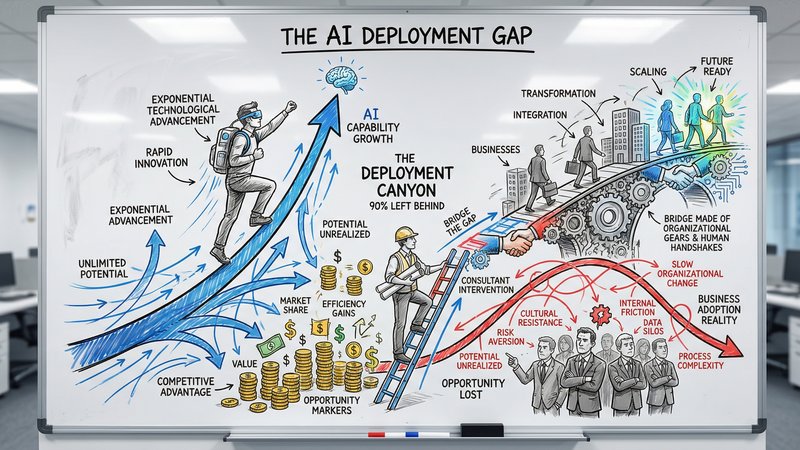
90% of Businesses Don't Use AI. That's the Opportunity.
90% of US businesses still don't use AI in production. The gap between capability and deployment is where the real opportunity lives for service businesses.

The Dark Side of Vibe Coding for Businesses
One year after the birth of vibe coding, the security incidents are adding up. Learn why speed without safety puts your business data at risk.
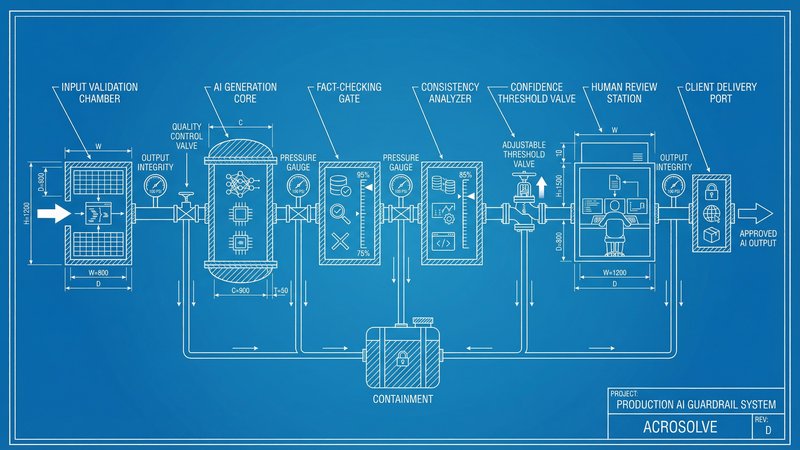
AI Reliability: The Missing Piece in Production Deployment
Only 31% of AI use cases reach production. The gap is not capability, it is reliability. Here is how to build AI systems your team and clients can actually trust.