90% of Businesses Don't Use AI. That's the Opportunity.
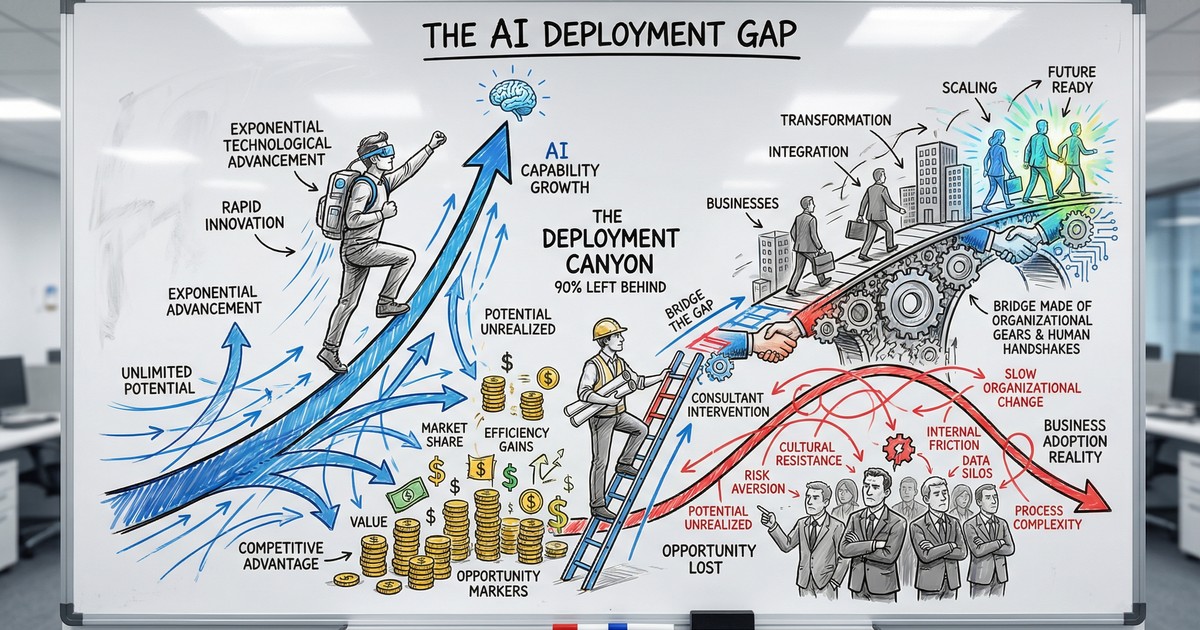
90% of US businesses still don't use AI in production. The gap between capability and deployment is where the real opportunity lives for service businesses.
The Number That Changes Everything
Matt Shumer’s viral essay “Something Big Is Happening” has been viewed over 80 million times. It argues AI has reached an inflection point. Models that are “substantially smarter than almost all humans at almost all tasks” are on track for 2026 or 2027. He describes giving AI a plain-English description of what he wants built, walking away for four hours, and coming back to finished software.
The capability trend is real. METR, the independent research organization measuring AI task completion, shows the length of tasks AI handles autonomously has been doubling roughly every seven months. OpenAI’s GPT-5.3 Codex was instrumental in creating itself. Anthropic’s Claude Opus 4.6 scores near-perfect on graduate-level reasoning benchmarks. The models released in early February 2026 represent a genuine step change.
But here is the number that reframes the entire conversation: 90% of American businesses still do not use AI in production.
Anthropic’s own economic research, published with Census Bureau data, shows AI adoption among US firms went from 3.7% in fall 2023 to 9.7% by August 2025. Two years of the fastest capability improvement in computing history, and fewer than one in ten businesses actually deploy it.
That single statistic tells you more about the real opportunity than any prediction about what AI will be able to do next year.
The Deployment Gap Is the Opportunity
There is a pattern in technology that repeats so consistently it should be a law: the capability curve is exponential, the deployment curve is logarithmic. The distance between those two lines is where the actual opportunity lives.
ISG’s 2025 enterprise study found only 31% of AI use cases reached full production. Lucidworks surveyed 1,600 AI leaders and found 71% of organizations have introduced generative AI, but only 6% have implemented agentic AI, the autonomous capability that dominates the headlines.
The bottleneck moved from capability to deployment: “can our organization actually deploy it.” And that second bottleneck runs on procurement cycles, compliance reviews, data infrastructure buildouts, change management, and institutional trust. None of those speed up the way model capabilities do.
For B2B service businesses, this gap is the window.
History Repeats: ATMs, Electricity, and AI
If you think the slow adoption curve is unique to AI, look at history.
ATMs deployed widely starting in the 1970s. The number of US bank tellers increased until 2007, three full decades later. ATMs made branches cheaper to operate, which expanded total branch count. The technology changed what the role required.
Electricity took 30 years to reshape manufacturing after the first power plants went live. Factories had to be physically redesigned around electric motors instead of steam-driven belt systems. The resistance was architectural. You could not just swap in an electric motor. You had to rethink the entire factory floor.
AI is following the same pattern. The Deloitte 2026 AI report found only 34% of companies are reimagining their business around AI. 83% of AI leaders report major concerns about generative AI implementation, an eightfold increase in two years.
The technology is ready. The organizations have not caught up.
Why Service Businesses Have the Biggest Advantage
Large enterprises move slowly by design. Their procurement cycles take months. Compliance reviews take quarters. Change management initiatives take years. A mid-market service business can move in weeks.
Here is what that looks like in practice:
Week 1: Identify the one workflow your team dreads most. Proposal writing, client onboarding, invoice processing, meeting follow-ups. Pick the pain point, not the flashiest use case.
Week 2: Run a pilot. One person, one workflow, one AI tool. Measure the time before and after. Do not mandate it across the team. Let the results speak.
Week 3-4: If it works, and in our experience it works about 70% of the time when scoped correctly, document the process and let the pilot user show the team.
The reason this works better for service businesses than for enterprises is simple: your processes are your product. When you automate proposal creation from two hours to fifteen minutes, that is not just an internal efficiency gain. It is a competitive advantage your clients feel directly through faster delivery and lower costs.
The Real Risk Is Not Moving Too Fast
People worry about moving too fast, about adopting tools before they are ready, about AI making mistakes. The actual risk is the opposite.
Businesses that ran half-hearted AI experiments in 2024 but never committed are now in a worse position than businesses that never started. Those experiments created organizational antibodies. The team tried AI, had a poor experience because implementation was rushed and unsupported, and now the response to every AI suggestion is: “We tried that. It did not work.”
Meanwhile, 94% of business leaders agree AI matters. Only 27% have built the structure to use it. That 67-point gap is pure inertia.
The businesses compounding their advantage right now figured out deployment. They redesigned workflows instead of layering AI on top. They trained their teams on specific tasks, not on AI as an abstract concept. They made adoption voluntary and visible.
Where the Opportunity Actually Lives
Here is the honest picture for B2B service businesses in 2026:
The capability gap is closing. AI can now handle tasks that took human experts hours. That curve is not slowing down.
The deployment gap is wide open. Over 90% of businesses have not figured out how to use AI in production. That gap closes slowly because it depends on human and organizational change, not technology.
The window is real. If you become the service provider that actually delivers faster, cheaper, and better because you figured out deployment while your competitors are still running pilots, your market position shifts.
The competitive environment is changing. The businesses who move now have a structural advantage over those who wait. If you want a framework for how to start, a structured 90-day pilot beats a 12-month roadmap every time.
Three things to do this week:
-
Audit one workflow end to end. Not theoretically. Sit next to the person who does it and time every step. That is your baseline.
-
Run one experiment. Pick the most painful step in that workflow and test whether AI can handle the first draft. Measure the difference.
-
Get an outside perspective. Your own bottlenecks are invisible from the inside. An external review surfaces the opportunities you are too close to see.
The capability curve is exponential. The deployment curve is logarithmic. The distance between those two lines is where the value is. And right now, that distance is enormous.
Ready to find out where your business stands? Take the AI Readiness Assessment and we will map your workflows against what actually works. No sales pitch. Just a clear picture of where the opportunity is.

Thom Hordijk
Founder
Get posts like this in your inbox every week
Weekly insights on AI and automation for B2B service businesses. No hype, just what works.
Related Articles
View all articles
Why Security Is the Real AI Adoption Bottleneck
Most AI adoption stalls on security concerns, not cost or talent. Learn how to address data privacy, GDPR, and AI security for business the right way.

Is AI Finally Built for Small Businesses?
AI used to demand enterprise budgets and IT teams. That's changed. Here's what's different now and how to tell if it's right for your business.

Why AI Deployment Needs Consulting Services
49% of businesses piloted AI tools in 2024. Only 4% deployed them at scale. The gap between buying AI and getting value from it is a services problem, not a technology one.